
Spatial Interaction Design
A Field-Based Workshop for Observing and Designing in Everyday Social Environments
NordiCHi 2026 - Vaasa, Finland - October 3 , 2026
Call for Participation
While interactive technologies are embedded in everyday settings, interaction is often framed at the device level, overlooking the relational dynamics of co-located people and objects. This can contribute to fragmented attention and disengagement between people and their surroundings. This workshop explores how interaction unfolds through spatial relations and how technology can support attunement, shared attention, and embodied experiences among co-located people.
Through a highly participatory and field-based format, we will explore new ways of understanding, observing, and designing spatial interactions through the Five Spatial Elements and the Spatial Probe. While the Five Spatial Elements offer a conceptual vocabulary for describing spatial relations—proximity, orientation, configuration, location, and locomotion—the Spatial Probe provides a designer-centered instrument for observing and documenting these relations in everyday environments.
Together, we will leave the workshop room and venture into nearby cafés, restaurants, and public spaces to investigate spatial interactions in the wild, uncover patterns and opportunities, and translate our observations into design concepts through collaborative ideation. Expect a workshop that is hands-on, exploratory, and social: a chance to walk through the city, discuss observations with fellow researchers and designers, and help shape emerging conceptual frameworks and design methods for Spatial Interaction Design.
Participation is now open to researchers, designers, educators, graduate students, and practitioners interested in Spatial Interaction Design. No position paper is required. To participate, please register through the NordiCHI registration page.
Come explore the city with us, investigate spatial interactions in the wild, and help shape emerging concepts and methods for Spatial Interaction Design. We look forward to seeing you in Vaasa!

Registration
Important Dates:
- Register Now
- Select a “Pre-conference (per day)” ticket.
- Choose “Spatial Interaction Design: A Field-Based Workshop for Observing and Designing in Everyday Social Environments.”
Only 5 spots remain. Workshop participation is limited to 14 participants and will take place in person in Vaasa, Finland, on October 3, from 9:30 AM to 5:30 PM.
If you have any questions, feel free to contact us.
Workshop Lenses
We welcome contributions that engage with one or more of the workshop’s three lenses:
Experiencing Space
This lens examines how spatial interactions are perceived and experienced. Examples include:
- Spatial perception and cognition
- Proxemics and interpersonal space
- Embodied interaction
- Presence and co-presence
- Shared attention and awareness
- Environmental psychology
Activating Space
This lens focuses on technologies and infrastructures that sense and respond to spatial relationships. Examples include:
- Spatial computing
- Extended Reality (XR)
- Context-aware computing
- Motion tracking and sensing
- Spatial multisensory outputs
- Ambient media and displays
Designing with Space
This lens centers on methods, representations, and practices for designing spatial interactions. Examples include:
- Design methods and workflows
- Tangible and embodied interaction
- Design ethnography
- Experience and service design
- Architecture and spatial design
- Speculative and participatory design
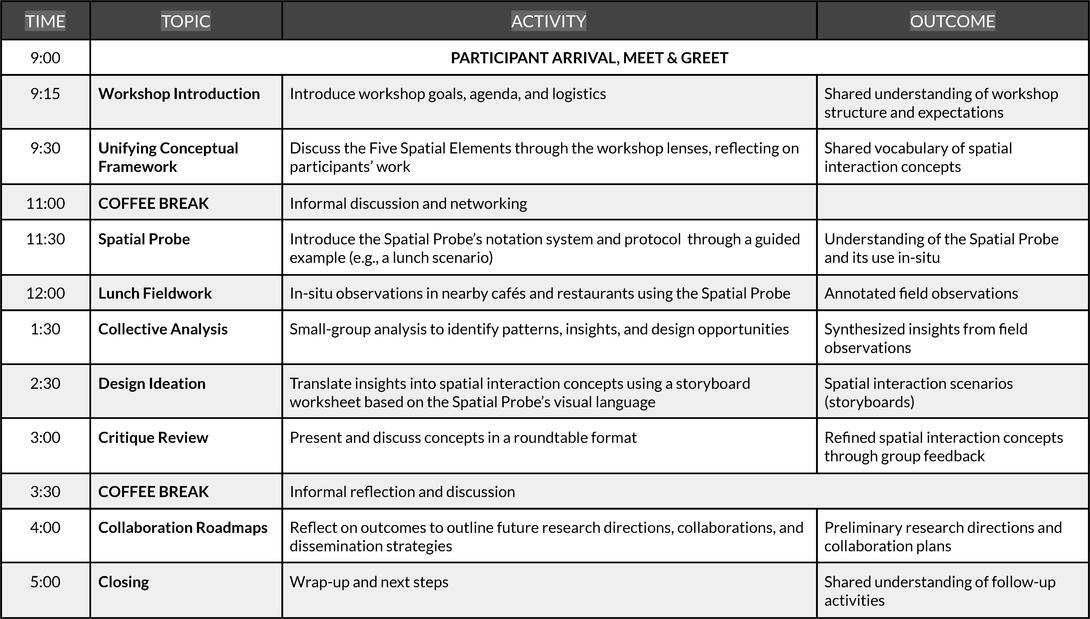
Agenda
Organizers
Daniel Rosenberg-Muñoz is an Assistant Professor in the School of Design at Carnegie Mellon University and Director of the Syntony Lab. His work spans HCI and architecture, focusing on spatial interactions in shared physical environments.
Brian O’Keefe is an Associate Professor of Interaction Design at the State University of New York, Farmingdale State College. His work explores mixed reality and blended experiences that integrate physical and digital environments.
Celine Park is an MDes student at Carnegie Mellon University with a background in UX design for AI and robotics at Samsung Electronics. Her work focuses on AI-driven spatial interactions in smart-home environments.
Serena Ge Guo is a Research Associate and Lecturer at the Information School, University of Wisconsin-Madison. Her research develops interactions that foster social connection, inclusivity, and playfulness in everyday surroundings.
Chang Hee Lee is an Associate Professor in the Department of Industrial Design at the College of Engineering, KAIST. His work explores sensory interaction and the design of systems that shape perception and engagement.