Learning to See East Liberty One Zine at a Time

For seven weeks this past fall, a group of undergrad students from Carnegie Mellon University's School of Design did something unusual: they slowed down. In a mini-course called Design Studies: Place, taught by PhD Researcher William Martin, they walked through East Liberty—a Pittsburgh neighborhood most had passed through but never really seen—and began asking questions about any kind of object - benches, doorways, graffiti, even plastic forks.
What started as observation became something deeper: a practice of noticing how design shapes the quiet, everyday mechanics of belonging. The course unfolded in two movements. First, students worked in teams to "compost" the neighborhood—breaking it down, layer by layer, to understand how different communities meet needs for rest, protection, participation, and meaning. They documented their findings in short videos, examining not just what objects exist, but how they mediate encounters between people. A bench isn't just a place to sit. It's where someone waits for a bus, where two strangers share space without speaking, where teenagers gather after school. Design, they learned, is never neutral.
Then came the second phase: "seeding". Each student chose a single designed object and traced its life from material extraction to disposal, asking how it connects—or disconnects—humans, nature, and community. The result was an 8-page zine, a small printed pamphlet that doubled as a poster when unfolded. These weren't polished solutions. They were speculative blueprints, creative provocations meant to ask: What if design could help us flourish together?

"Previous to this course, I had never thought of this item past its obvious usage of seating," reflected Lynn Kim who chose to focus on benches. Kim's research revealed something more: benches create pause. They slow us down, offer a moment to appreciate the present, and bring people together. In her zine, she explored how this one object quietly stitches communities together, both within East Liberty and beyond. What seemed mundane became meaningful.

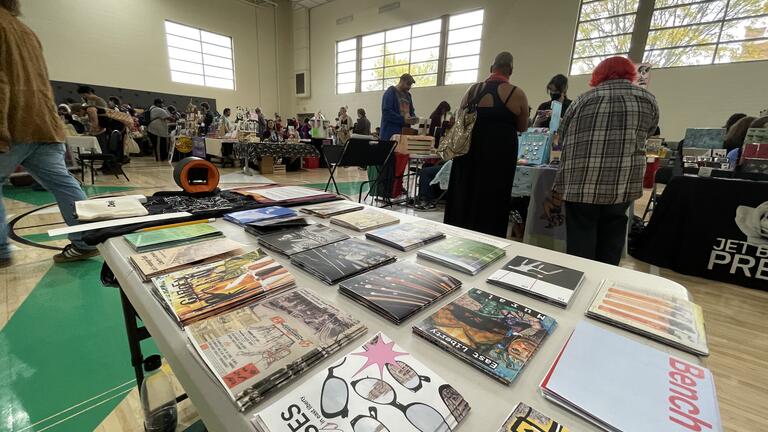
Anya Clemente took a different route and focused on eyeglasses. She traced them across systems—where materials are sourced, where they're produced, used, discarded. Along the way, she discovered a tension. Glasses help people see, express identity, and navigate the world, but their production and disposal create environmental harm. "This contrast between help and hinder reveals how design is always tied to place, people, and nature," said Clementine. To mirror that complexity, she took a creative risk of cutting transparent holes into her zine pages by hand with an Exacto knife, making the reader look through layers to understand the object's dual nature. The class voted it most visually appealing.
What emerges from these reflections isn't just skill-building, It's transformation.
"Studying East Liberty opened my eyes to details I used to pass without a second thought," said Kim. Clementine's understanding shifted too—from looking at multiple objects in one place to examining one object across many places, learning to see design as a web of consequences.
The project culminated at the Pittsburgh Zine Fair, where students shared their work with the broader community. Ideas, quite literally, returned to circulation. It's a fitting end for a course built on metaphors of growth: composting what exists, seeding what could be.
William Martin sees this work as essential. Through risk-taking, collaboration, and relational inquiry, students learn that analysis and creation are both acts of care. "Place-centered design can help communities imagine, cultivate, and grow the conditions for shared flourishing," explained Martin.

"Although this was an individual project, collaboration played an important role," added Clementine. Classmates troubleshooted printers, traded feedback, shared inspiration in a supportive and creative environment.
The real lesson of the exercise is that design isn't just about objects, it's about how we see, connect, and care for the systems we live within. One bench, one pair of glasses, one neighborhood at a time.