Designing Holiday Magic: Joel Neely and the Craft Behind New York City’s Iconic Window Displays
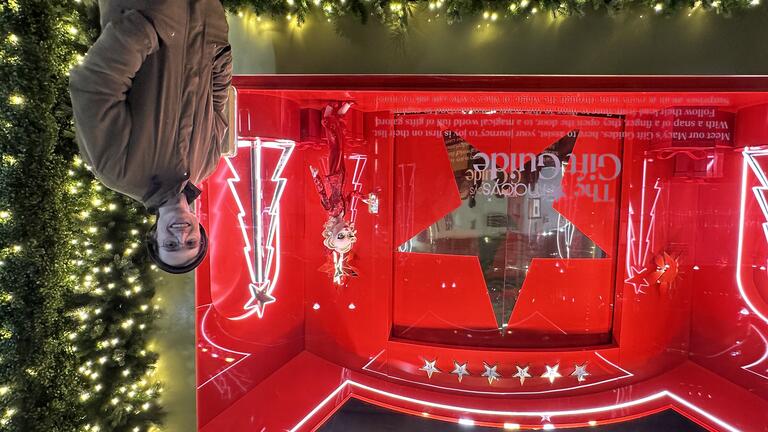

Each winter, New York City transforms. Storefronts glow, sidewalks slow, and crowds gather to peer into department store windows that have become as much a holiday tradition as ice skating in Rockefeller Center or the lighting of the tree. While these displays feel effortless—whimsical, nostalgic, and perfectly timed—the work behind them is anything but invisible.
For Carnegie Mellon University’s School of Design Alumnus Joel Neely (BDes ’21), the holiday season means long days in the shop, late nights on installations, and the satisfaction of seeing months of fabrication come together on some of the world’s most famous retail stages. As a core team member at Spaeth Design in New York City, Neely has spent the last five years helping design, build, and install holiday windows for Saks Fifth Avenue, Macy’s, Bergdorf Goodman, and Tiffany & Co. In 2025, he led the Saks Fifth Avenue windows account, overseeing the design, fabrication, and installation of the Manhattan displays that now draw crowds along Fifth Avenue.
From CMU to the Shop Floor

When Neely graduated in 2021, he was unsure of exactly where he wanted to land, but he was clear on one thing: he wanted to build. “My only major goal leaving college was to be in a space where I could help build things,” said Neely.
After refining his portfolio and applying widely, Neely took a temporary fabrication job in Queens. That role became his entry point into Spaeth Design, a specialty fabrication studio that creates custom window displays, museum installations, trade show environments, and one-off pieces for artists and brands.
Over the past four and a half years, Neely has worked across nearly every area of the shop. He began with hands-on fabrication before moving into lighting and installation. He became the studio’s primary CNC machinist, assisting with component design and technical problem-solving. After several years in that role, he was invited to begin designing full displays and leading parts of the shop through the busiest seasons. This year marked a milestone: leading the Saks Fifth Avenue windows account and contributing to more than 20 holiday displays for major retail clients.
Holiday Windows as Urban Theater

“Winter in NYC is always festive,” said Neely. “The amount of effort that goes into holiday decor is unmatched by practically any city in the world.”
This year marked the return of the iconic Saks Fifth Avenue light show after a hiatus—an event that transforms the entire façade of the building into a choreographed spectacle of light and music. Neely is especially drawn to projects that treat architecture itself as part of the display. Around the city, he points to standout moments like Louis Vuitton’s wrapped scaffolding, Dior and Chanel’s animated building facades, and Cartier’s illuminated illustrations that turn entire storefronts into visual narratives.
One surprising shift in recent years: many holiday windows no longer feature products at all.
“Instead, they’re meant to represent holiday scenes and evoke feelings of nostalgia,” Neely explains. At Macy’s, for example, this year’s windows tell the story of the company’s history in New York City. One of his favorites features rotating triangular forms, each face revealing a different moment: Macy’s historic façade, its modern exterior, and a glimpse inside—an animated story told through form, motion, and light.
The Craft Behind the Spectacle

What excites Neely most about the work is its variety—and its challenges. Every project differs in style, materials, and timeline. Many are true one-offs, built once and never repeated. That reality makes the process both rewarding and demanding.
“Making the first version of an object is typically the hardest,” explained Neely. “A lot of the time, that’s all we get to do.”
Much of the studio’s work requires developing new techniques for unfamiliar materials or finishes. Neely takes pride in documenting those processes so that hard-won knowledge isn’t lost. He recalls a recent year dominated by DiBond, an aluminum composite material commonly used in signage. While visually refined, its exposed edges posed a challenge. The team experimented with rabbited joints, trims, and painted edges to solve the problem—solutions that now live on as shared studio knowledge rather than forgotten experiments.
Learning While Doing

Neely credits his School of Design education with providing the foundation for his current work—from software fluency to drawing and design principles. At the same time, working alongside experienced fabricators quickly revealed how much there is to learn through making.
“There is a lot of nuance needed when working with different materials,” said Neely. “You only learn these things by doing—what glue works, how to machine different materials, how to handle delicate laminates.”
Looking back, Neely remembers CMU as a place filled with passionate makers. Favorite classes included How Things Are Made with Wayne Chung and Drawing Spaces and Nature with Mark Mentzer. Factory visits and drawing courses left a lasting impression, reinforcing the connection between design thinking and real-world production.
Advice for Future Designers

For students interested in a similar path, Neely emphasizes that fabrication is a broad and often overlooked design space. “If you want to work with your hands and actually make objects yourself, this could be the right path for you,” said Neely.
From carpentry and welding to machining, lighting, sculpting, and project management, fabrication studios rely on diverse skill sets. Neely encourages students to lean into whatever area of making excites them most. “Being passionate about a specific area of making is a great place to start.”
As holiday crowds pause to admire glowing windows and animated scenes this season, few will think about CNC bits, edge treatments, or installation logistics, but for Joel Neely, that behind-the-scenes work is exactly where the magic begins.